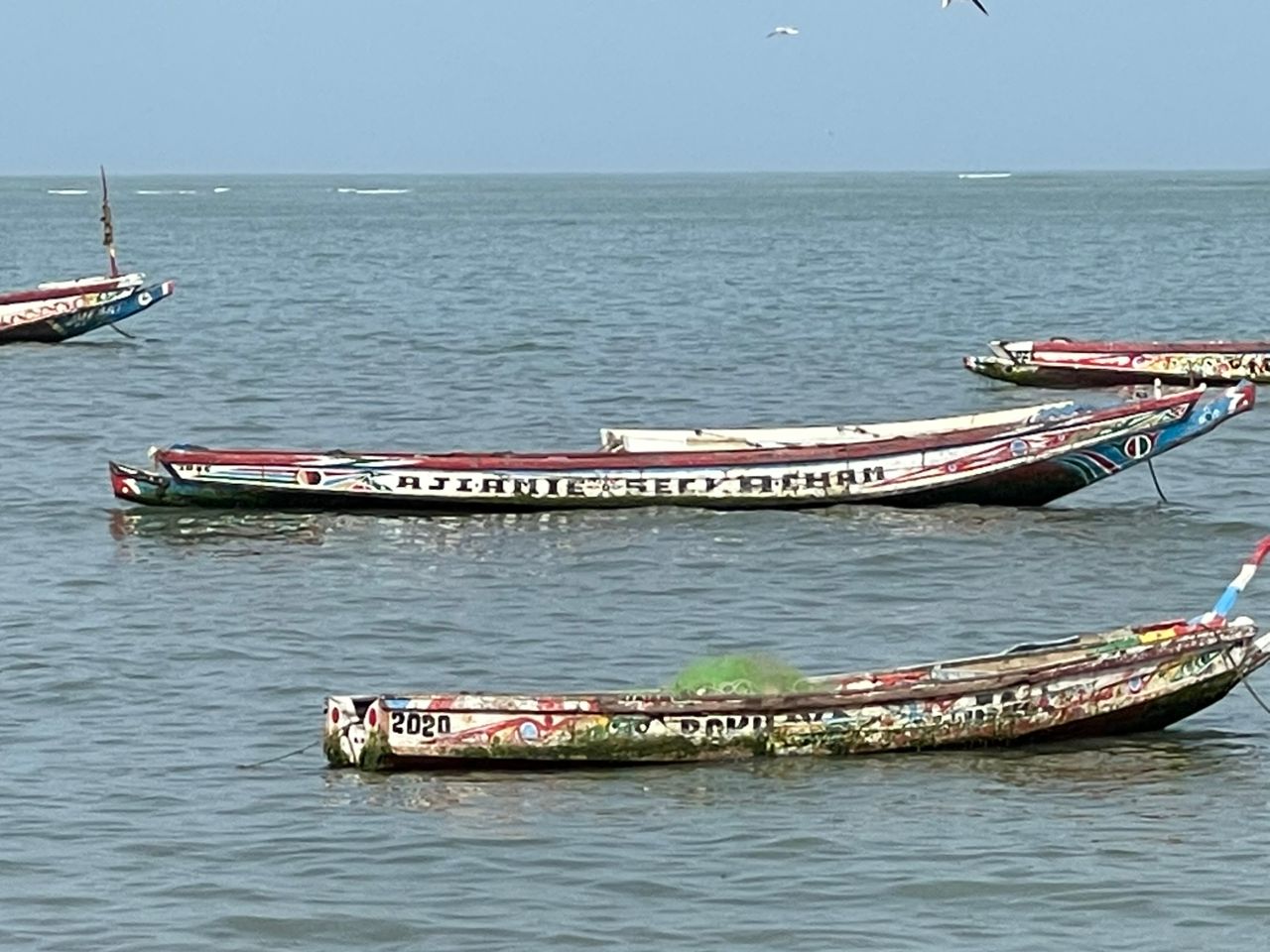



The boundary between survival and death for a green sea turtle along the Gambian coastline could just be twenty meters of the beautiful sandy beach. Nestled within a coastal tapestry of ancient baobab trees and mangroves sits a modest six-by-six-meter house. It is the heart of a sanctuary operating under seemingly impossible odds. This is the Turtle Village.
Inside the structure, located within a protected Bolong Fenyoto wildlife park—a renowned haven for birds and birdwatchers alike—are two carefully maintained water ponds.
One holds six older, mature green sea turtles; the other houses three younger batches. A community of local activists in Gunjur hatches over a thousand turtles a year, but due to the high risk facing this species, their survival rate to breeding age is very low.
“When newly hatched turtles are released, they are vulnerable to being eaten by fish or birds, killed by boats or caught by fishing nets,” said Abubacarr Saho, an activist in a community of conservationists helping to protect the species. “Research has shown that for every one thousand turtles released at sea, only one is likely to reach breeding age.”
To improve their survival chances, the activists came up with a pond to grow the turtles to maturity prior to release. Come August, they are striving to tag six older cohorts with GPS tracking devices and release them back into the wild, providing critical data for a battle that is currently fought entirely in the dark.
DONATE via Paypal or Wave to SUPPORT our INVESTIGATIONS.
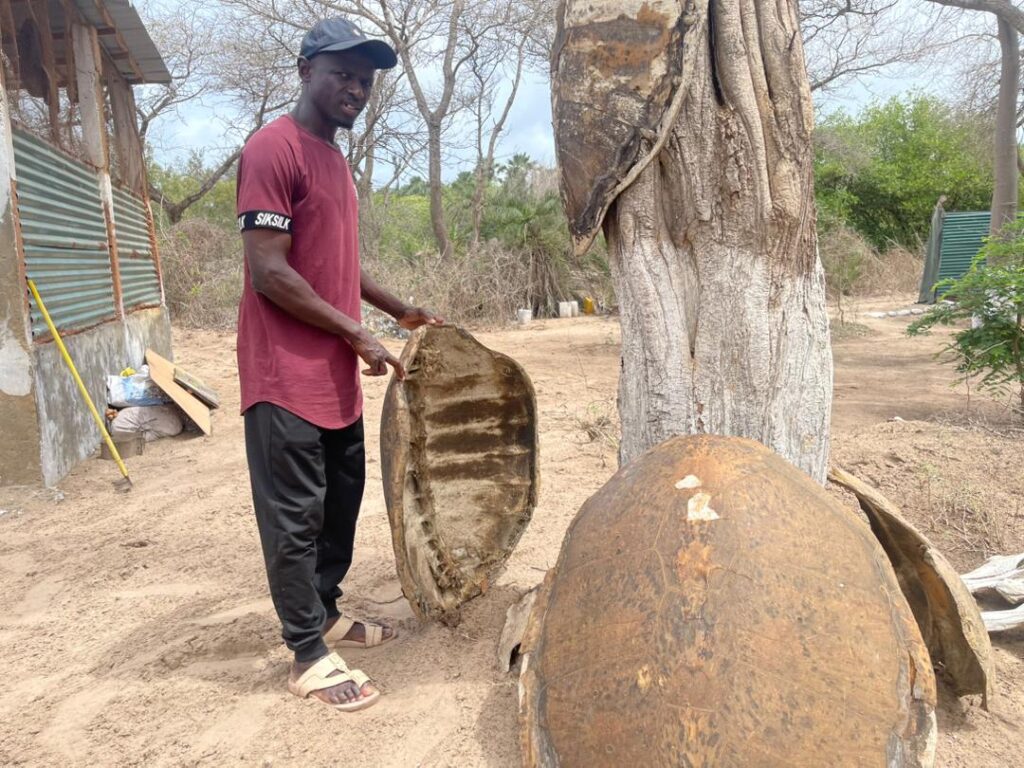
Outside the house, the village is secured by a fence woven from palm branches and ironwood. But before you reach the threshold, your eyes are drawn upward. Hanging from the branches of a nearby tree are three massive carapaces—the dome-shaped top shells of slaughtered turtles. Bleached by the sun and rattling gently in the ocean breeze, they are grim trophies of this local war. The carapaces are a reminder of the reality the green turtles face, said Saho. One of the turtles that belonged to those shells had laid 140 eggs before she was slaughtered sometime last year.

From painting brush to conservation
A former schoolteacher and trained carpenter, Saho spent his free time as an abstract painter. For years, he used his brush to depict the complexities of nature on concrete walls. But by 2020, the destruction occurring on the beaches of Gunjur forced him to lay down the brush to step onto the sand.
In response to widespread poaching and habitat loss, seven local groups and eco-tourism establishments decided to merge. They formed the Gunjur Conservationist and Eco-Tourism Association, and Saho was appointed to head the turtle monitoring committee.
Today, Saho leads a dedicated team of 53 volunteers. By July, when the nesting of green turtles begins, they will patrol beaches at night to find their nest.
“They crawl out of the ocean, and we track their marks on the ground to find their nests,” he said.
When a nest is discovered, the team performs a quick risk assessment. If it is located in a ‘safe zone,’ it is left untouched and monitored. But safe zones are becoming a luxury along the Gambian coast. If the nest is exposed, the volunteers carefully dig out the eggs and transport them to a locally built hatchery.
The process is an exercise in meticulous mimicry. “We measure the exact depth, size, and width of the original hole,” explained Saho. “We observe the precise way the eggs are layered into the earth so we can replace the exact environment in which they were laid. That is the only way they survive.”
The work requires constant adaptation. The project’s original hatchery—a simple four-by-six-meter fenced perimeter with netting and pillars at Gunjur beach—was completely swept away by severe coastal erosion driven by climate change. Undeterred, the team rebuilt. Their new hatchery sits near Kartong, by the Santosa Beach Bar, roughly three kilometres away from the Turtle Village.
The clock is always ticking. “If a nest has been in the ground for more than 24 hours, it is too late—we cannot move it without damaging it. That is why we must patrol from the evening into the night,” said Saho.

A race with predators
Gambia’s Biodiversity and Wildlife Act (2003) listed green turtles as ‘flagship species’, prohibiting their harvesting, commercial sale or possession. Section 61 provides for a fine of up to D50,000, a two-year jail term, or both for killing the creature, while Section 68(3) imposes a similar penalty on anyone involved in the commercial sale of its products.
Historically, the entire 200-mile Gambian coastline was a thriving nesting ground for marine turtles. Today, that territory is shrinking rapidly, partly due to tourism-related activities in much of the coastline, observed Naffie Gaye, a staff member with Parks and Wildlife, a state agency tasked with the protection of wildlife. The agency is also the local implementing partner of the Convention on International Trade in Endangered Species of Wild Fauna and Flora, which lists the green turtle as a least concern species, and until recently, one of the critically endangered species. Parks has been rendering training to the community organisations.
“The entire coastline from Kartong to Nuimi is a nesting area,” said Gaye, who did her thesis on turtle conservation. “The turtles move to much quieter places as tourism activities encroach on much of the beach spaces.”
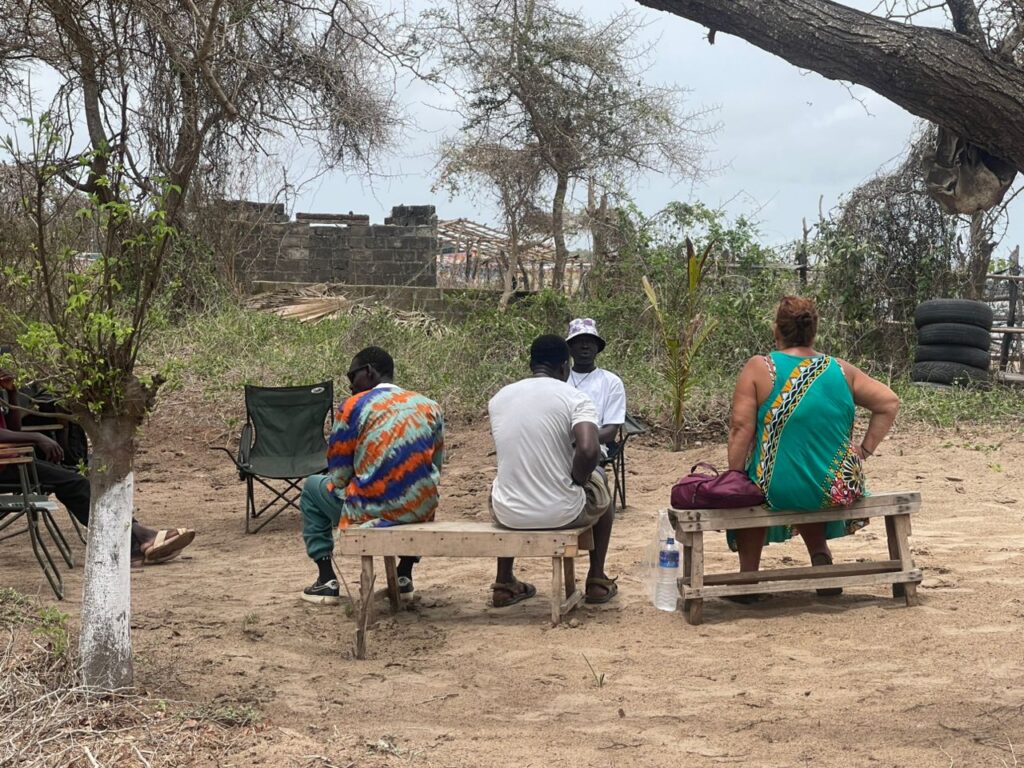
But hunting is also a problem. Cherno Yum Jadama, the current manager of the turtle village, knows this risk well. “There were people here who were dedicated, professional turtle hunters,” said Jadama.
“They understood the nesting periods perfectly. Anyone who knows turtles can follow their tracks straight to the nest. Turtles try to hide their eggs; they scrub the surface of the sand to disguise the spot, but an experienced poacher always finds it. People love the eggs, and they love the meat.”
Last year, a nesting mother was slaughtered right next to her site. She left behind one hundred and forty–nine eggs. On June 22, as conservationists prepared for the 2026 nesting season, another turtle was found dead on the Gunjur beach, just another example of how vulnerable green turtles are.
Beyond human poachers, a modern ecological imbalance has introduced a new wave of threats. Along the beaches in Gunjur, the country’s biggest fishmeal factory—Golden Lead—frequently purchases spoiled fish washed up on the shores from local women. This steady supply of waste attracts scavengers, but when the spoiled fish runs low, stray dogs, monitor lizards, and ghost crabs that feed on them spread out across the sand dunes.
With no other food available, the buried turtle nests become their ultimate prey.
To counter this, patrols are timed precisely with the ocean’s rhythms. Turtles come ashore to nest exclusively at high tide. The volunteers monitor the tide charts, deploying for two to four hours at a time, often staying out until 4:00 AM.
The financial incentives for the patrollers are small. The association charges eco-tourists for visits to the turtle village, using the revenue to hand out a meagre D100 ($1.35) or D200 ($2.71) to the volunteers to cover their nighttime expenses. The rest of the earnings are used for the upkeep of the Turtle Village, such as turtle feeds and the expenses of the one staff member who manages the facility.
And yet, despite the overwhelming challenges, the association’s localised efforts are achieving astonishing numbers. “We can release up to 1,200 turtles a year,” said Jadama.


The ‘golden goose’
The ecological stakes could not be higher. Green sea turtles are the literal gardeners of the marine ecosystem. By grazing continuously on seagrass meadows, they stimulate fresh, healthy growth. This upkeep prevents seagrass from becoming overgrown and choked with algae, preserving vital nursery grounds for the very commercial fish stocks that feed the Gambian population.
Despite this, a local conservationist, Ahmed Manjang, said the fishermen continue to kill the golden goose that lays the golden egg.
Between February 2025 and January 2026, Manjang ran a targeted project focusing on turtle bycatch, stranding, and rehabilitation. His data revealed that turtle mortalities and accidental net captures are highest in Brufut and Tanji—the areas with the highest density of commercial fishing activity in the country.
But even in his native Gunjur—where he and his colleagues are involved in conservation measures complemented by rigorous beach patrols and sensitisation—they recorded 29 turtle deaths in under twelve months.
“The demand for turtle eggs and meat remains incredibly high,” said Manjang. “Without these community conservation initiatives, the situation would be catastrophic.”
There are ongoing sensitisation efforts to discourage fishermen and community members from killing sea turtles, but this drive is suffocated, according to Jadama, by a deep-rooted belief that every part of a marine turtle possesses potent medicinal properties.
In June, just about the same time Gambian authorities placed a temporary ban on night fishing, turtles started mating. And because they float on water as they mate, the fishermen can see them. In the absence of active tracking devices on released turtles or scientific studies to understand their population, conservationists could only rely on sightings or net encounters by fishermen.
Salifu Ndure is a fisherman who has worked with conservationists. He participated in the data collection of turtle bycatch led by Manjang. The present efforts, according to Ndure, are paying dividends, but they are sabotaged by overfishing.
“… They (green turtles) are still at sea, and we see them,” said Ndure.
“… The conservation efforts have contributed to saving a lot of them. But the amount of overfishing at sea threatens every marine life.”


The hope on the horizon
Despite the steep incline, the tide of community sentiment is slowly turning, according to conservationists. Years of door-to-door sensitisation are paying off.
“The community is finally helping us,” Saho said. “They are becoming sensitive to the idea that these creatures must be protected. Now, we receive phone calls from villagers informing us about turtle sightings, strandings, or nests. We ask them to share their GPS locations via their phones, we find the spot, and we protect it.”
The communities grow nearer to the creature through facilities like the Turtle Village, and students visit the turtles to learn about them. And their eco–tourism value brought to the communities new opportunities that might have surpassed the value of the meat or the eggs. And the authorities have recognised the impact of this community-led sensitisation, said Gaye.


The impact of this grassroots movement in Gunjur and Sanyang is already rippling outward. In the nearby village of Tujereng, community activists recently underwent training at the Gunjur turtle village, determined to replicate the hatchery model on their own local beachfront. Lamin Sonko leads the team. He said his team is preparing to begin night patrols starting in July when nesting begins.
Sonko’s community beachfront neighbours Tanji, the largest fish landing site in the country. Activists say there is a strong correlation between higher fishing activity and turtle bycatch.
“I have already started engaging people in my community about turtle conservation. There was a strong pushback at the beginning, but more and more people are beginning to understand the need to protect sea turtles,” said Sonko.
Elsewhere in Sanyang, Omar Sanyang has been active in saving turtles. Like the Turtle Village in Gunjur, they also received funding from the National Environmental Agency to create a pond where they could nurture turtles before release, conduct scientific studies and rehabilitate wounded ones. Like the new pond built in Sanyang, the proximity of the Turtle Village to the ocean allows the turtles to enjoy seawater, which is pumped in fresh water every week using a generator.
For many activists, saving the green turtle can feel like fighting against nature itself. However, long-term conservation efforts are paying off. In October 2025, the world reaped the fruits of the efforts of conservationists. The International Union for Conservation of Nature (IUCN) updated its Red List of Threatened Species, moving the global status of the green sea turtle from “Endangered” to “Least Concern.”
DONATE via Paypal or Wave to SUPPORT our INVESTIGATIONS.
This story was originally produced and published by Dubawa, a West African independent verification and fact-checking project, initiated by the Centre for Journalism Innovation and Development (CJID).